By Amit Kapoor and Nandini Vats
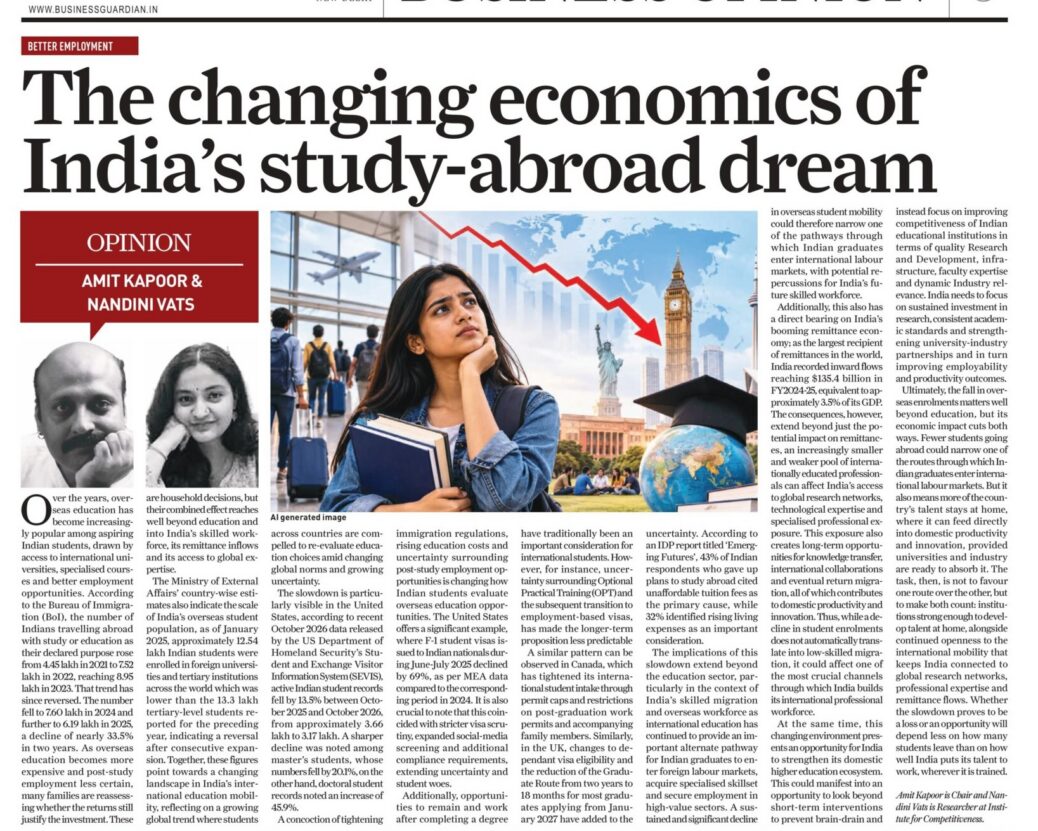
Over the years, overseas education has become increasingly popular among aspiring Indian students, drawn by access to international universities, specialised courses and better employment opportunities. According to the Bureau of Immigration (BoI), the number of Indians travelling abroad with study or education as their declared purpose rose from 4.45 lakh in 2021 to 7.52 lakh in 2022, reaching 8.95 lakh in 2023. That trend has since reversed. The number fell to 7.60 lakh in 2024 and further to 6.19 lakh in 2025, a decline of nearly 33.5% in two years. As overseas education becomes more expensive and post-study employment less certain, many families are reassessing whether the returns still justify the investment. These are household decisions, but their combined effect reaches well beyond education and into India’s skilled workforce, its remittance inflows and its access to global expertise.
The Ministry of External Affairs’ country-wise estimates also indicate the scale of India’s overseas student population, as of January 2025, approximately 12.54 lakh Indian students were enrolled in foreign universities and tertiary institutions across the world which was lower than the 13.3 lakh tertiary-level students reported for the preceding year, indicating a reversal after consecutive expansion. Together, these figures point towards a changing landscape in India’s international education mobility, reflecting on a growing global trend where students across countries are compelled to re-evaluate education choices amid changing global norms and growing uncertainty.
The slowdown is particularly visible in the United States, according to recent October 2026 data released by the US Department of Homeland Security’s Student and Exchange Visitor Information System (SEVIS), active Indian student records fell by 13.5% between October 2025 and October 2026, from approximately 3.66 lakh to 3.17 lakh. A sharper decline was noted among master’s students, whose numbers fell by 20.1%, on the other hand, doctoral student records noted an increase of 45.9%.
A concoction of tightening immigration regulations, rising education costs and uncertainty surrounding post-study employment opportunities is changing how Indian students evaluate overseas education opportunities. The United States offers a significant example, where F-1 student visas issued to Indian nationals during June-July 2025 declined by 69%, as per MEA data compared to the corresponding period in 2024. It is also crucial to note that this coincided with stricter visa scrutiny, expanded social-media screening and additional compliance requirements, extending uncertainty and student woes.
Additionally, opportunities to remain and work after completing a degree have traditionally been an important consideration for international students. However, for instance, uncertainty surrounding Optional Practical Training (OPT) and the subsequent transition to employment-based visas, has made the longer-term proposition less predictable
A similar pattern can be observed in Canada, which has tightened its international student intake through permit caps and restrictions on post-graduation work permits and accompanying family members. Similarly, in the UK, changes to dependant visa eligibility and the reduction of the Graduate Route from two years to 18 months for most graduates applying from January 2027 have added to the uncertainty. According to an IDP report titled ‘Emerging Futures’, 43% of Indian respondents who gave up plans to study abroad cited unaffordable tuition fees as the primary cause, while 32% identified rising living expenses as an important consideration.
The implications of this slowdown extend beyond the education sector, particularly in the context of India’s skilled migration and overseas workforce as international education has continued to provide an important alternate pathway for Indian graduates to enter foreign labour markets, acquire specialised skillset and secure employment in high-value sectors. A sustained and significant decline in overseas student mobility could therefore narrow one of the pathways through which Indian graduates enter international labour markets, with potential repercussions for India’s future skilled workforce.
Additionally, this also has a direct bearing on India’s booming remittance economy; as the largest recipient of remittances in the world, India recorded inward flows reaching $135.4 billion in FY2024-25, equivalent to approximately 3.5% of its GDP. The consequences, however, extend beyond just the potential impact on remittances, an increasingly smaller and weaker pool of internationally educated professionals can affect India’s access to global research networks, technological expertise and specialised professional exposure. This exposure also creates long-term opportunities for knowledge transfer, international collaborations and eventual return migration, all of which contributes to domestic productivity and innovation. Thus, while a decline in student enrolments does not automatically translate into low-skilled migration, it could affect one of the most crucial channels through which India builds its international professional workforce.
At the same time, this changing environment presents an opportunity for India to strengthen its domestic higher education ecosystem. This could manifest into an opportunity to look beyond short-term interventions to prevent brain-drain and instead focus on improving competitiveness of Indian educational institutions in terms of quality Research and Development, infrastructure, faculty expertise and dynamic Industry relevance. India needs to focus on sustained investment in research, consistent academic standards and strengthening university-industry partnerships and in turn improving employability and productivity outcomes.
Ultimately, the fall in overseas enrolments matters well beyond education, but its economic impact cuts both ways. Fewer students going abroad could narrow one of the routes through which Indian graduates enter international labour markets. But it also means more of the country’s talent stays at home, where it can feed directly into domestic productivity and innovation, provided universities and industry are ready to absorb it. The task, then, is not to favour one route over the other, but to make both count: institutions strong enough to develop talent at home, alongside continued openness to the international mobility that keeps India connected to global research networks, professional expertise and remittance flows. Whether the slowdown proves to be a loss or an opportunity will depend less on how many students leave than on how well India puts its talent to work, wherever it is trained.
(Amit Kapoor is Chair and Nandini Vats is Researcher at Institute for Competitiveness.)
The article was published with The Sunday Guardian on November 8, 2026.