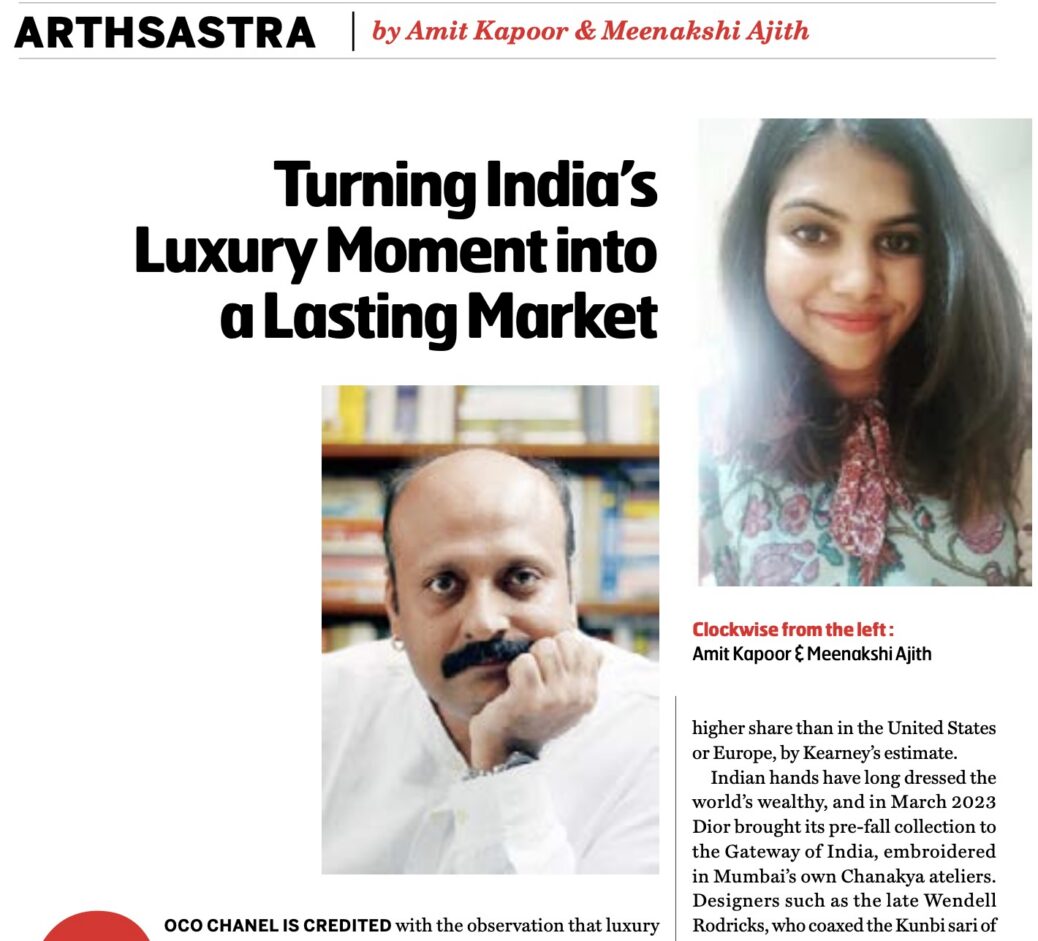
Amit Kapoor and Meenakshi Ajith
Coco Chanel is credited with the observation that luxury is “a necessity that begins where necessity ends”, though the Maharaja of Patiala, who in 1928 took delivery from Cartier of a necklace set with 2,930 diamonds, might have wondered where exactly necessity was supposed to end. India has long understood indulgence on that scale, and in the weeks before Diwali it remembers how, as silks are sent rippling across the white-sheeted floors of old sari shops, gold is weighed out for Dhanteras and the great houses of Paris and Milan receive their customers at addresses of their own in Mumbai. Chanel’s sentence carries a condition that is easy to miss amid so much shimmer, for it supposes that by the time the indulgence begins, the necessities have been seen to.
India is now talked of as one of the world’s growing markets for fine attire, dining and experiential travel. Kearney expects the country’s luxury market to approach $12 billion by 2028, and its 2026 outlook counts India among the fastest-growing luxury markets of 2025, with analysts expecting such spending to rise 18 per cent a year as the number of ultra-wealthy Indians climbs. The appetite has travelled well beyond the metros, and Tata CLiQ Luxury says that non-metro markets account for about 55 per cent of its revenue. The Indian taste remains stubbornly its own, with jewellery accounting for more than 10 per cent of luxury spending here, a higher share than in the United States or Europe, by Kearney’s estimate.
Indian hands have long dressed the world’s wealthy, and in March 2023 Dior brought its pre-fall collection to the Gateway of India, embroidered in Mumbai’s own Chanakya ateliers. Designers such as the late Wendell Rodricks, who coaxed the Kunbi sari of Goa’s tribal women back onto the loom, and Rahul Mishra, the first Indian on the Paris Haute Couture calendar, have built names on that inheritance. The world has not always returned the compliment, and Bloomberg found in 2023 that a jacket from a leading French house, retailing for almost €43,000, carried a “Made in France” label although exporters reckoned on more than 2,000 hours of embroidery in India and under 100 hours of finishing in Europe. Prada, which sent sandals inspired by the humble Kolhapuri chappal down a Milan runway in 2025, partnered with the state corporations that hold the craft’s geographical indication only after an outcry.
The economics beneath India’s luxury market still form a steep pyramid, and Kearney places the rising wealthy among its luxury buyers, with incomes of $70,000 to $180,000, in the top 2 per cent of Indian earners. Even its ambitious achievers, for whom luxury is a means of personal transformation, earn $30,000 to $70,000 a year and come from families worth more than $500,000. Blume Ventures’ Indus Valley report found last year that the richest 10 per cent of Indians account for 66 per cent of discretionary spending, a consuming class that is deepening faster than it is widening. Mercedes-Benz India sold fewer cars in 2025 yet earned record revenue as sales of its top-end models rose 12 per cent, in a country where luxury cars make up just over 1 per cent of the 4.4 million cars sold.
The young are finding their way in on easier terms, as the average export price of India’s lab-grown diamonds fell from $388.77 a carat in 2022 to $71.13 in the first five months of 2026. With gold so dear, Indians bought 15.4 per cent less jewellery by weight in the April-June quarter than a year earlier while paying 34.4 per cent more, as buyers turned to lighter, lower-carat pieces, the World Gold Council reported. Credit does the rest, and Counterpoint Research expects 42 per cent of the smartphones sold this year to be bought on loan, while the Reserve Bank has noted that more than half the unsecured loans on fintech lenders’ books went to people under 35.
What this generation finds hardest to buy is the necessity that luxury takes for granted. In the big cities a home near work has drifted from a milestone of salaried life towards an asset class, and builders have followed the money upmarket. Salaries have risen more slowly than the profits of the firms that pay them, and the deposit on a flat has a way of retreating just as it comes into view. A young professional can carry a phone and a holiday on easy instalments, yet the one purchase meant to anchor a life asks for more than a young salary can bear.
The economist Fred Hirsch explained half a century ago why growth makes ordinary goods cheaper while bidding up positional ones such as land near good jobs. For many young Indians the old order of things has been reversed, with the indulgence arriving first, often in instalments, while the necessity keeps its distance.A market that grows by selling more to the same households can prosper for years, though it rests on the fortunes of a few. Durable luxury markets have generally been carried by a broad, propertied middle class that graduates over a lifetime from the small indulgence to the considered purchase, a progression that depends on things no boutique sells, homes within reach of work and pay that keeps pace with profits. The makers need a foundation of their own, in Indian houses confident enough to put a “Made in India” label on the craft the world’s ateliers already rely on.
Chanel’s line is usually quoted as a definition of luxury, though it describes a well-ordered economy just as well, one in which indulgence follows security and is the more enjoyable for it. India already has the craft, the appetite and the wealth at the top to sustain a great luxury market, and if it widens the circle of households with a secure home and a rising incomes, this season’s boom can become the next generation’s habit.
(Amit Kapoor is chair and Meenakshi Ajith is development policy lead at Institute for Competitiveness. X:@kautiliya).
The article was published with Business World on November 7, 2026.