
By Amit Kapoor & Sheen Zutshi
As AI and automation reshape entry-level jobs, India must move away from siloed governance toward a connected pipeline that prepares workers for lifelong adaptability.
India’s human capital deficits are clear. Learning outcomes vary, progression falters at key stages, and many schools lack teachers and infrastructure. Few workers receive formal vocational training, and graduates still face employability concerns.
These facts are no longer surprising; policy debates have documented and reiterated them. The question is no longer whether gaps exist in learning skills or the employment ecosystem. The question is why these gaps exist. They span interconnected stages of the same human capital continuum, prompting the question: what kind of governance architecture can address them?
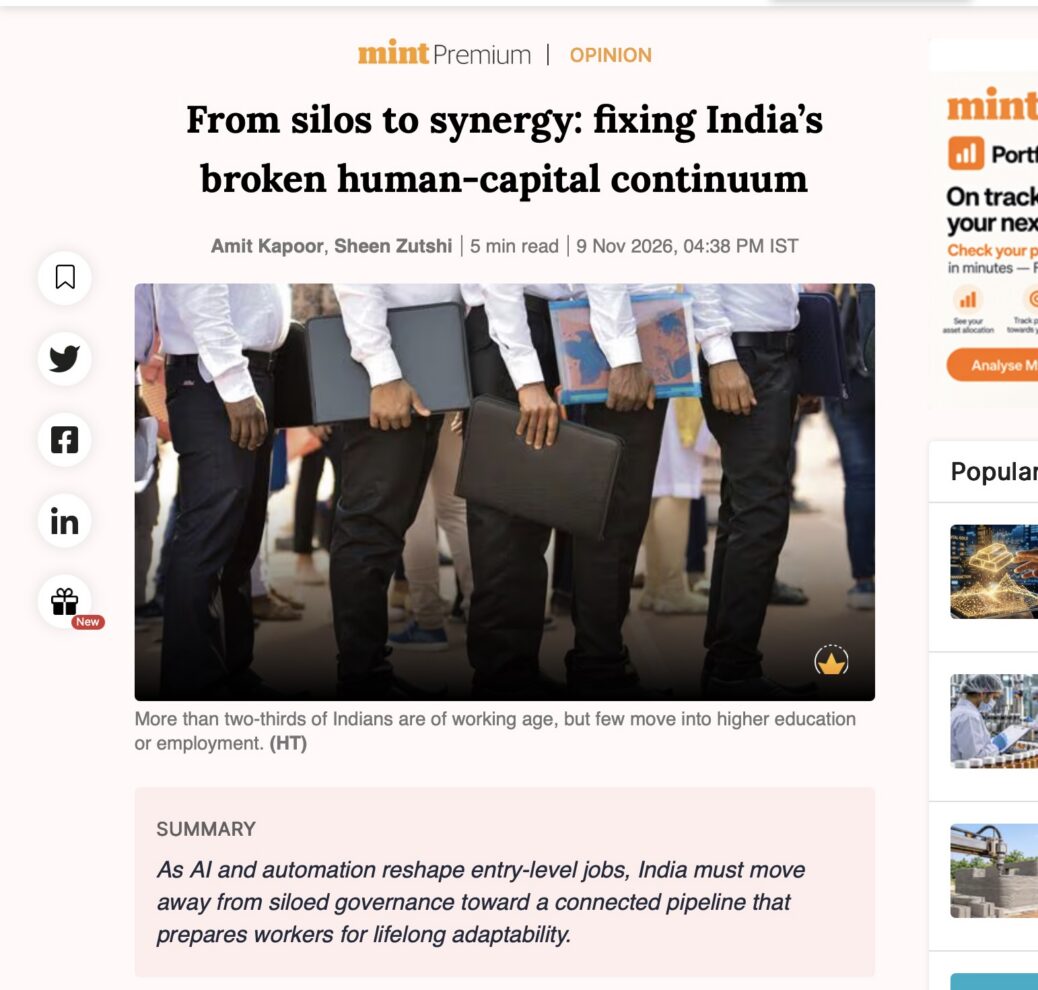
More than two-thirds of Indians are of working age, but few move into higher education or employment. NITI Aayog’s recent report, Reimagining Skilling for Viksit Bharat@2047, found 86.7 million people aged 15-29 are not in education, employment or training. The Institute for Competitiveness’ Skill Landscape Report, submitted to the skill ministry in 2025, revealed that 88% of workers hold low-competency jobs and just 10-12% hold high-competency ones. Only 8.25% of graduates work in roles matching their qualifications. These figures reveal weak transitions across the continuum, which is a concern as AI, automation, digital platforms and new systems reshape work.
The first rungs of many career ladders are being compressed as routine documentation, analysis, coding, support and back-office tasks are no longer just labour-intensive work. India must prepare young people for a job market where needs and frontiers keep shifting, and not merely today’s vacancies. Weak foundational learning and limited career exposure already determine who benefits from higher education and work. The country must address these gaps while preparing learners for an economy increasingly dependent on adaptability, problem-solving, and continuous learning.
Human capital is a core factor in productivity, shaping whether firms, sectors, and regions can use technology, capital, and innovation effectively. It encompasses more than years of schooling or certificates: it also means being able to learn, adapt, solve problems, work with technology, and continually upgrade skills throughout life. A young population, therefore, does not automatically deliver a demographic dividend, especially as the nature of work changes faster than the systems that prepare people for it. Education, skilling, and labour are interconnected, and states and the Centre share responsibility for outcomes throughout people’s lives.
The labour market is where outcomes become visible, not where the challenge begins. The real challenge runs along a continuum, from early childhood development and foundational learning through schooling, higher education, vocational training and work to lifelong adaptability. That continuum has a strong subnational dimension. One region may face weak foundational learning, another poor transition from school to work, another weak absorption of trained workers. Each child enters with different circumstances, school quality, language and opportunity.
A credible strategy must therefore combine national coordination with state- and district-level diagnosis so that the education, skilling and labour ministries can respond to the gaps each young person brings into the labour market. By the time a learner reaches grade 8 or 10, or a formal skilling programme, the gap may already be too large. If the starting point is unequal, skilling cannot equalise outcomes on its own.
Governing across silos
At this point, the ministry of skill development and entrepreneurship (MSDE) is expected to build vocational and technical training capacity and close the gap between the demand for and supply of skills. In practice, it inherits learners after eight to ten years of education. If they have weak literacy, numeracy, or career awareness, sector skill councils, industrial training institutes (ITIs), and Pradhan Mantri Kaushal Vikas Yojana (PMKVY) centres focus on repairing these deficits before developing advanced skills. That is a failure of continuum design rather than a limitation of MSDE, and the continuum is currently governed through separate institutional worlds.
The ministry of education oversees schooling and higher education; MSDE oversees vocational training; and the ministry of labour and employment oversees labour policy, social security, and employment. Each mandate is legitimate, but citizens experience the system as a whole, while gaps between its parts go unreported.
Education must flag learners’ preparedness gaps, skilling must identify training challenges, and labour must show which occupations are growing and which capabilities are rewarded. Without this feedback, each system measures its own progress while learners face the gaps between them. This makes a strongest case for convergence, not a mechanical merger. Ministries must share accountability for what they inherit, produce, and pass on, changing how the government measures success.
Harmonising data systems
Digital architecture can support this task, but it cannot replace it. The Unified District Information System for Education (UDISE), Performance Assessment, Review, and Analysis of Knowledge for Holistic Development (PARAKH), Annual Status of Education Report (ASER), All India Survey on Higher Education (AISHE), and Periodic Labour Force Survey (PLFS) already capture parts of the journey, but not where the continuum breaks. The Automated Permanent Academic Account Registry (APAAR) ID, as a portable academic identity, is a welcome step toward addressing this gap. Until these data systems are harmonised and linked, and departments across these ministries resolve coordination challenges, state-level diagnostics remain essential for identifying where the continuum leaks.
As technology reshapes work, India must avoid fragmented efforts to prepare its workforce for an evolving labour market. It must move from separate systems to a single human capital continuum. Competitiveness will depend not only on how many people India educates and trains, but also on whether their capabilities remain relevant and are continuously renewed. This cannot wait until 2047.
Amit Kapoor is chair and Sheen Zutshi is research manager at the Institute for Competitiveness. Amit Kapoor is on Twitter at @kautiliya.
The article was published with Mint on November 9, 2026.


