By Amit Kapoor and Saptrishi Mondal
In an economy where capital can cross borders in seconds and supply chains are redrawn within a few years, the speed and reliability of the state have become part of what a country offers the world, as much as its ports, power and people. Timely transactions and easy procedures are now a public asset, one that lowers the cost of doing business when put to productive use. Governments are beginning to treat their own machinery as a source of value instead of an overhead to be tolerated.
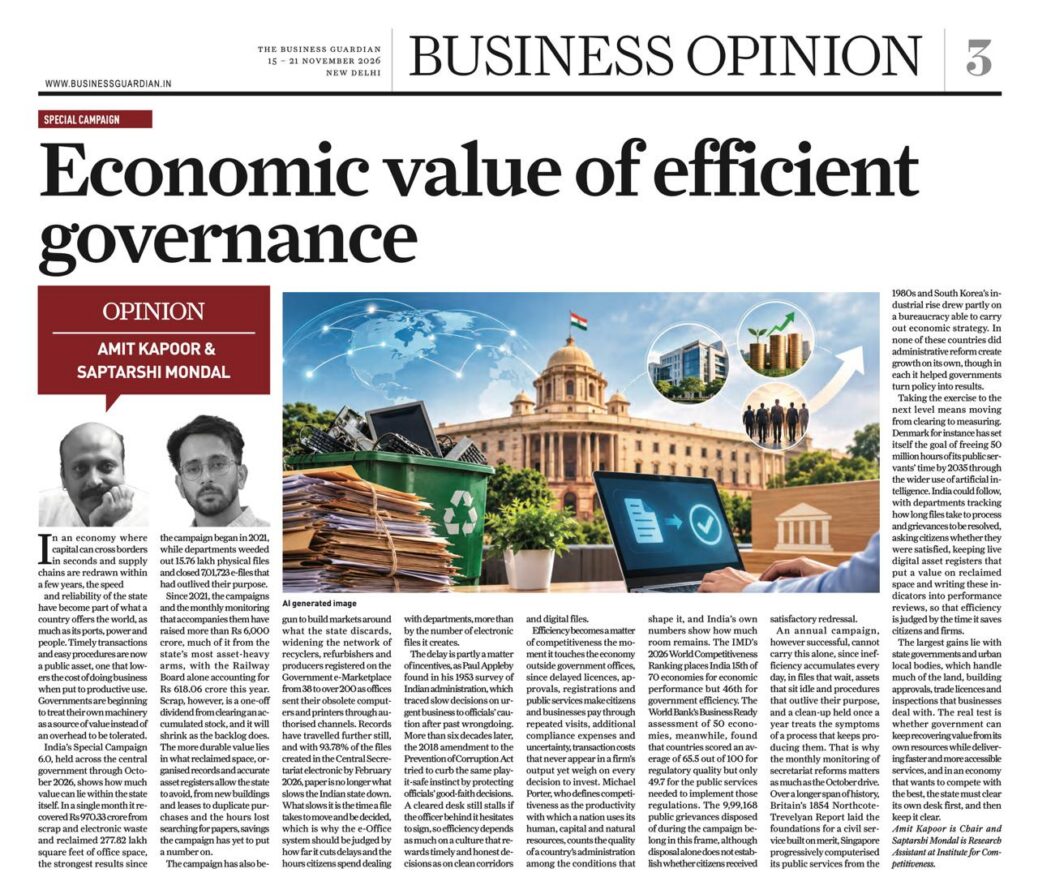
India’s Special Campaign 6.0, held across the central government through October 2026, shows how much value can lie within the state itself. In a single month it recovered ₹970.33 crore from scrap and electronic waste and reclaimed 277.82 lakh square feet of office space, the strongest results since the campaign began in 2021, while departments weeded out 15.76 lakh physical files and closed 7,01,723 e-files that had outlived their purpose.
Since 2021, the campaigns and the monthly monitoring that accompanies them have raised more than ₹6,000 crore, much of it from the state’s most asset-heavy arms, with the Railway Board alone accounting for ₹618.06 crore this year. Scrap, however, is a one-off dividend from clearing an accumulated stock, and it will shrink as the backlog does. The more durable value lies in what reclaimed space, organised records and accurate asset registers allow the state to avoid, from new buildings and leases to duplicate purchases and the hours lost searching for papers, savings the campaign has yet to put a number on.
The campaign has also begun to build markets around what the state discards, widening the network of recyclers, refurbishers and producers registered on the Government e-Marketplace from 38 to over 200 as offices sent their obsolete computers and printers through authorised channels. Records have travelled further still, and with 93.78% of the files created in the Central Secretariat electronic by February 2026, paper is no longer what slows the Indian state down. What slows it is the time a file takes to move and be decided, which is why the e-Office system should be judged by how far it cuts delays and the hours citizens spend dealing with departments, more than by the number of electronic files it creates.
The delay is partly a matter of incentives, as Paul Appleby found in his 1953 survey of Indian administration, which traced slow decisions on urgent business to officials’ caution after past wrongdoing. More than six decades later, the 2018 amendment to the Prevention of Corruption Act tried to curb the same play-it-safe instinct by protecting officials’ good-faith decisions. A cleared desk still stalls if the officer behind it hesitates to sign, so efficiency depends as much on a culture that rewards timely and honest decisions as on clean corridors and digital files.
Efficiency becomes a matter of competitiveness the moment it touches the economy outside government offices, since delayed licences, approvals, registrations and public services make citizens and businesses pay through repeated visits, additional compliance expenses and uncertainty, transaction costs that never appear in a firm’s output yet weigh on every decision to invest. Michael Porter, who defines competitiveness as the productivity with which a nation uses its human, capital and natural resources, counts the quality of a country’s administration among the conditions that shape it, and India’s own numbers show how much room remains. The IMD’s 2026 World Competitiveness Ranking places India 15th of 70 economies for economic performance but 46th for government efficiency. The World Bank’s Business Ready assessment of 50 economies, meanwhile, found that countries scored an average of 65.5 out of 100 for regulatory quality but only 49.7 for the public services needed to implement those regulations. The 9,99,168 public grievances disposed of during the campaign belong in this frame, although disposal alone does not establish whether citizens received satisfactory redressal.
An annual campaign, however successful, cannot carry this alone, since inefficiency accumulates every day, in files that wait, assets that sit idle and procedures that outlive their purpose, and a clean-up held once a year treats the symptoms of a process that keeps producing them. That is why the monthly monitoring of secretariat reforms matters as much as the October drive. Over a longer span of history, Britain’s 1854 Northcote-Trevelyan Report laid the foundations for a civil service built on merit, Singapore progressively computerised its public services from the 1980s and South Korea’s industrial rise drew partly on a bureaucracy able to carry out economic strategy. In none of these countries did administrative reform create growth on its own, though in each it helped governments turn policy into results.
Taking the exercise to the next level means moving from clearing to measuring. Denmark for instance has set itself the goal of freeing 50 million hours of its public servants’ time by 2035 through the wider use of artificial intelligence. India could follow, with departments tracking how long files take to process and grievances to be resolved, asking citizens whether they were satisfied, keeping live digital asset registers that put a value on reclaimed space and writing these indicators into performance reviews, so that efficiency is judged by the time it saves citizens and firms. The largest gains lie with state governments and urban local bodies, which handle much of the land, building approvals, trade licences and inspections that businesses deal with. The real test is whether government can keep recovering value from its own resources while delivering faster and more accessible services, and in an economy that wants to compete with the best, the state must clear its own desk first, and then keep it clear.
(Amit Kapoor is Chair and Saptarshi Mondal is Research Assistant at Institute for Competitiveness.)
The article was published with The Sunday Guardian on November 15, 2026.