
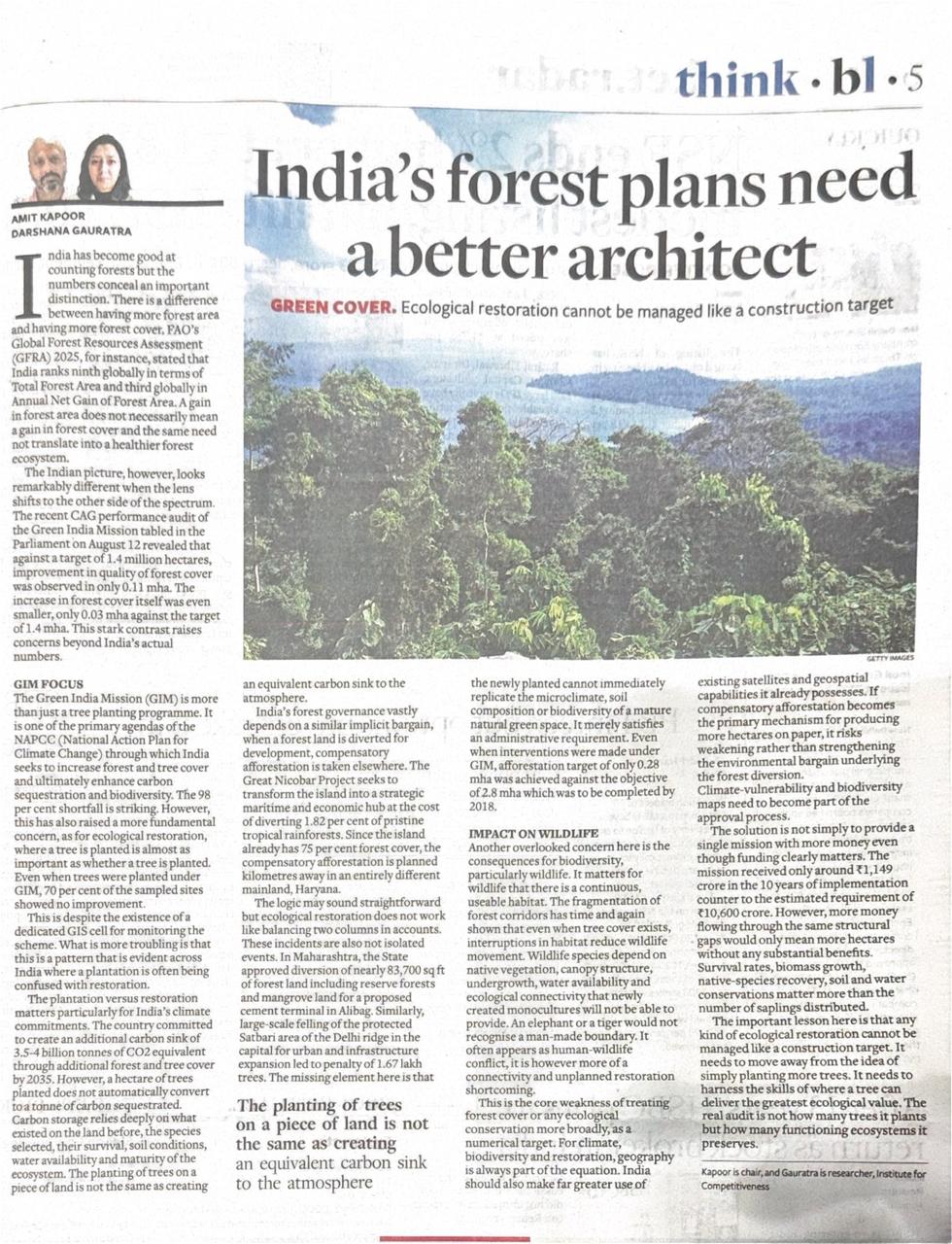
By Amit Kapoor and Darshana Gauratra
India has become good at counting forests but the numbers conceal a very important distinction. There is a difference between having more forest area and having more forest cover. FAO’s Global Forest Resources Assessment (GFRA) 2025, for instance, stated that India ranks 9th globally in terms of Total Forest Area and 3rd globally in Annual Net Gain of Forest Area. A gain in forest area does not necessarily mean a gain in forest cover and the same need not translate into a healthier forest ecosystem. The Indian picture, however, looks remarkably different when the lens shifts to the other side of the spectrum. The recent CAG performance audit of the Green India Mission tabled in the Parliament on 12th August revealed that against a target of 1.4 million hectares, improvement in quality of forest cover was observed in only 0.11 mha. The increase in forest cover itself was even smaller, only 0.03mha against the target of 1.4 mha. This stark contrast raises concerns beyond India’s actual numbers.
The Green India Mission (GIM) is more than just a tree planting programme. It is one of the primary agendas of the NAPCC through which India seeks to increase forest and tree cover and ultimately enhance carbon sequestration and biodiversity. The 98 per cent shortfall is striking. However, this has also raised a more fundamental concern as for ecological restoration, where a tree is planted is almost as important as whether a tree is planted. Even when trees were planted under GIM, 70 per cent of the sampled sites showed no improvement. This is despite the existence of a dedicated GIS cell for monitoring the scheme. What is more troubling is that this is a pattern that is evident across India where a plantation is often being confused with restoration.
The plantation versus restoration matters particularly for India’s climate commitments. The country committed to create an additional carbon sink of 3.5 to 4.0 billion tonnes of CO2 equivalent through additional forest and tree cover by 2035. However, a hectare of trees planted does not automatically convert to a tonne of carbon sequestrated. Carbon storage relies deeply on what existed on the land before, the species selected, their survival, soil conditions, water availability and maturity of the ecosystem. The planting of trees on a piece of land is not the same as creating an equivalent carbon sink to the atmosphere.
India’s forest governance vastly depends on a similar implicit bargain, when a forest land is diverted for development, compensatory afforestation is taken elsewhere. The Great Nicobar Project seeks to transform the island into a strategic maritime and economic hub at the cost of diverting 1.82 per cent of pristine tropical rainforests. Since the island already has 75per cent forest cover, the compensatory afforestation is planned kilometres away in an entirely different mainland, Haryana. The logic may sound straightforward but ecological restoration does not work like balancing two columns in accounts. These incidents are also not isolated events. In Maharashtra, the state approved diversion of nearly 83,700 sq ft of forest land including reserve forests and mangrove land for a proposed cement terminal in Alibag. Similarly, large-scale felling of the protected Satbari area of the Delhi ridge in the capital for urban and infrastructure expansion led to penalty of 1.67 lakh trees. The missing element here is that the newly planted cannot immediately replicate the microclimate, soil composition or biodiversity of a mature natural green space. It merely satisfies an administrative requirement. Even when interventions were made under GIM, afforestation target of only 0.28mha was achieved against the objective of 2.8mha which was to be completed by 2018.
Another overlooked concern here is the consequences for biodiversity, particularly wildlife. It matters for wildlife that there is a continuous, useable habitat. The fragmentation of forest corridors has time and again shown that even when tree cover exists, interruptions in habitat reduce wildlife movement. Wildlife species depend on native vegetation, canopy structure, undergrowth, water availability and ecological connectivity that newly created monocultures will not be able to provide. An elephant or a tiger would not recognise a man-made boundary. It often appears as human-wildlife conflict, it is however more of a connectivity and unplanned restoration shortcoming.
This is the core weakness of treating forest cover or any ecological conservation more broadly, as a numerical target. For climate, biodiversity and restoration, geography is always part of the equation. India should also make far greater use of existing satellites and geospatial capabilities it already possesses. If compensatory afforestation becomes the primary mechanism for producing more hectares on paper, it risks weakening rather than strengthening the environmental bargain underlying the forest diversion. Climate-vulnerability and biodiversity maps need to become part of the approval process.
The solution is not simply to provide a single mission with more money even though funding clearly matters. The mission received only around ₹1,149 Crores in the 10 years of implementation counter to the estimated requirement of ₹10,600 crore. However, more money flowing through the same structural gaps would only mean more hectares without any substantial benefits. Survival rates, biomass growth, native-species recovery, soil and water conservations matter more than the number of saplings distributed.
The important lesson here is that any kind of ecological restoration cannot be managed like a construction target. It needs to move away from the idea of simply planting more trees. It needs to harness the skills of where a tree can deliver the greatest ecological value. The real audit is not how many trees it plants but how many functioning ecosystems it preserves.
(Amit Kapoor is chair and Darshana Gauratra is researcher, Institute for Competitiveness. X:@kautiliya)
The article was published with Hindu Business Line on September 20, 2026.


